Meet Kevin Pisacich, CT
Connecticut Might Just ARPA Its Way to Universal Coverage
I need to include another author’s disclosure in this week’s profile: I lived in Connecticut for a dozen years, got my MBA from UConn, and pretend to be a big fan of the Huskies when they make deep runs in March Madness (it’s better than watching Indiana fall apart).
Lay of the Land Nutmeg State
Connecticut is almost two states, two separate cultures. There’s the lower West part of the state, Fairfield County, which serves as a ‘home’ for many who work in NYC.
In the middle of the state is the capital, Hartford, which seems to have the insurance industry on lockdown. But my personal favorite Hartford feature when I lived there was a 16K capacity arena that was attached to a shopping mall. I got a slice, a pretzel, and then walked into a U2 show back in the day.
The northeast area of the state is close enough to Boston to get some ‘spillover’ connectivity, but the northwest of the state is the most rural and perhaps the most in need of (better) broadband.
The state has a robust middle mile infrastructure to aid in connecting BSLs and providers have been quite active building service to more and more BSLs the past several years, without grant funding.
Finally, the state has 13 islands (14 if you count Kings Island) in the Long Island Sound, with a population of 100 or so BSLs that may be disappointed to learn that they’ll be in the ‘alternative technology’ bucket.
Goals aren’t “Whalers,” but the Numbers are Still “Husky”
I sat down with Kevin Pisacich, Connecticut Broadband Director, with great interest in my former home state.
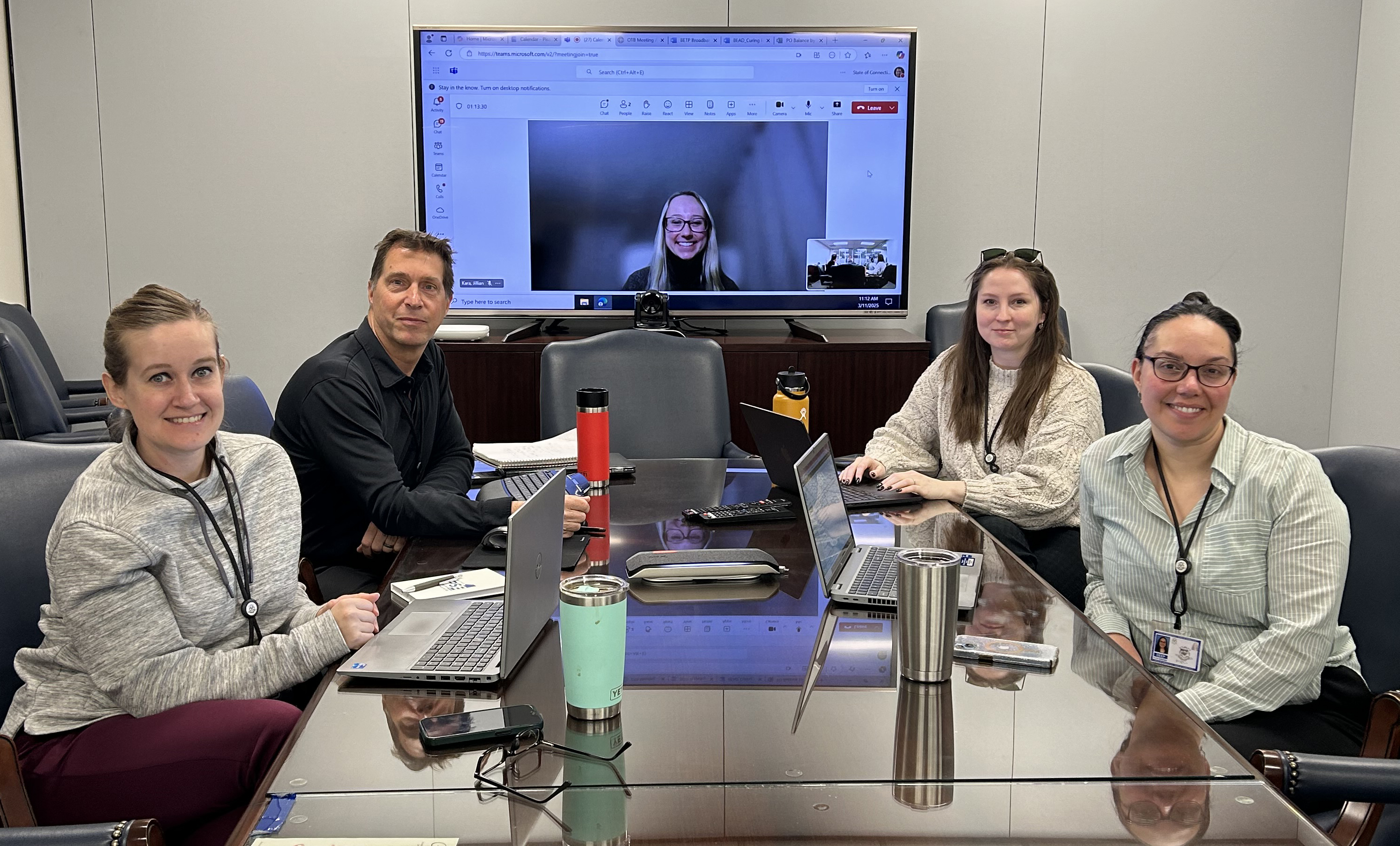
Pisacich describes his team of five in Hartford as a hybrid, hardworking, and extremely talented group of people dedicated to the state.
Pisacich realizes how fortunate his office and the state are to start the ARPA and BEAD program rollouts with numbers that almost every state (except maybe North Dakota) would envy/trade for. Specifically, post challenges and an approved map turns up only 7,200 BSLs that are unserved or underserved. The state’s current coverage is greater than 99%. And before you ask, the 7,200 does not include committed BSLs from ARPA or other programs.
I asked Pisacich what he attributes Connecticut’s tremendous coverage to, and he credits years and years of stakeholder engagement and an active provider ecosystem within Connecticut to improve the state’s connectivity. Those of us who have been in the industry for more than we care to admit can remember hearing about grassroots efforts to improve connectivity in the state more than a decade ago.
“There's so much stakeholder engagement in our communities as well as the statewide community,” says Pisacich. “From providers to local leaders, to community organizations, to other state agencies and partners.”
A Governor who Understands Broadband’s Merritt Parkway
Another big moment for the state was electing Ned Lamont its governor in 2019. Lamont’s own cable/telecom background led him to, from day one, take great interest in improving the state’s broadband.
In 2021, Lamont led efforts to pass a state broadband bill, Public Act 21-159. The legislation established the broadband office to oversee ARPA and BEAD.
Within the same bill, the state government mandated a goal to reach connectivity of one gig access down by 100 Mbps up. This big picture goal/mandate will influence Pisacich and his team to go ‘all in’ on fiber within ARPA and BEAD applications.
“These speeds are the state’s base level mandate. The BEAD guideline of 100 by 20 means nothing to Connecticut,” explains Pisacich. “To respect both the Federal programs and the state mandate, we've been prioritizing fiber. Plus, when you look at the BEAD guidelines, it is loud and clear that the program wants fiber prioritized.”
ARPA Then AND Now
Connecticut received $141.9 million in ARPA/CPF funding. The plan was for more than $40 million to be dedicated to infrastructure and reaching the unserved and underserved. Approximately $100 million will go to myriad projects including upgrading the state’s own network, improving all schools’ connections, building network redundancies, digital access, and additional WiFi placed within CAIs.
Additionally, because Connecticut has a low broadband ‘adoption rate’ (87%), some of the CPF funds will go towards programs to educate and drive adoption.
“The beauty of the Capital Projects Program is you don't need to just rely on the FCC map like you do for BEAD,” says Pisacich. “There are more means to designate areas as underserved. This leads us to encourage localities to look at the CPF program dollars [~$100 million] remaining.”
Progress Pre-BEAD
Before a single dime of ARPA or BEAD funds is spent in Connecticut, the challenge process landed on only 7,200 unserved and underserved BSLs.
“We're in the middle of distributing ARPA grants right now,” explains Pisacich. “We did recently announce grants in round one of ARPA that covered about 3,300 locations.”
7,200 – 3,300 = 3,900 BSLs
And Pisacich says the next round of ARPA will take ‘thousands’ of underserved and unserved off the map. “Round two will take roughly another couple thousand off our already low (7,200) BSL number.
3,900 – ~2,000 = 1,900 BSLs
“We're happy to get the job done now as quickly as we can using ARPA funds and seeing everyone served sooner,” says Pisacich.
Still Need BEAD
Volume two was approved for Connecticut in July, leaving Pisacich and his team a little less than six months to get its BEAD plan finalized.
Round one of BEAD applications closed in late February, netting more than 250 applications. Pisacich estimates that when Connecticut officially wraps up ARPA projects, the allocated $144.2 million may only need to reach a few thousand BSLs.
Pisacich believes Connecticut will only need one round of BEAD funding, “…we built in a good curing and negotiation period to help make that happen.”
Once universal BSL access is achieved, he says that leftover funds will be used to benefit the state’s 1,500 BEAD-eligible CAIs. “Let's take the opportunity to fund these community anchor organizations with the connections they need. We plan to use excess finding available to as many community anchors as we can,” says Pisacich. Beyond building out broadband to CAIs, the state expects to use any remaining BEAD funds on digital access and adoption efforts.
“There's no reason we cannot get this done. Our BEAD allocation is sufficient, we have great and willing providers, demonstrated by the fact that back when $144 million in BEAD was allocated to us, our estimate of the unserved and underserved was way higher,” says Pisacich. “But all the work we've been doing for two years to drive awareness and involve everyone in the conversation, the providers have escalated build-out in advance of these programs, which is fantastic.”
UCONN’t Believe the Progress Kevin is Making!
Pisacich started his telecom career in the more lucrative (and risky) private sector. After a few companies he was with ended up ‘overextending assets,’ Pisacich would end up accepting an invitation from a fellow churchgoer to help build a fiber network in Oxnard, California. “I'll say I got bit by the public service sector bug, you know, working for that city, it was just an absolute blast, " recalls Pisacich.
Pisacich moved back to his home state to take the reins of the Department of Energy & Environmental Protections’ Office of Telecommunications & Broadband in 2022, finding great satisfaction in the post. “What we're doing is going to make a difference for this state for the next 50 years. I can't imagine going back to the private sector because I would miss out on the personal satisfaction of impacting communities and citizens.”
Pisacich, a native of Connecticut, lives along the southeastern Connecticut shoreline in Pawcatuck with his wife and young son.