Meet Kevin Hughes, DC
Washington DC’s Broadband Commander
Sometimes we forget that the BEAD program isn’t just for the 50 states, but also for the five inhabited U.S. territories and our nation’s capital, Washington DC.
I sat down with DC’s Kevin Hughes for broadband.io to learn more about DC (more than I did on a middle school trip) and what exactly an Administrator, District of Columbia State Broadband and Digital Equity Office (DC SBDEO), a department within DC’s Office Of The Chief Technology Officer (OCTO), is up to concerning BEAD.
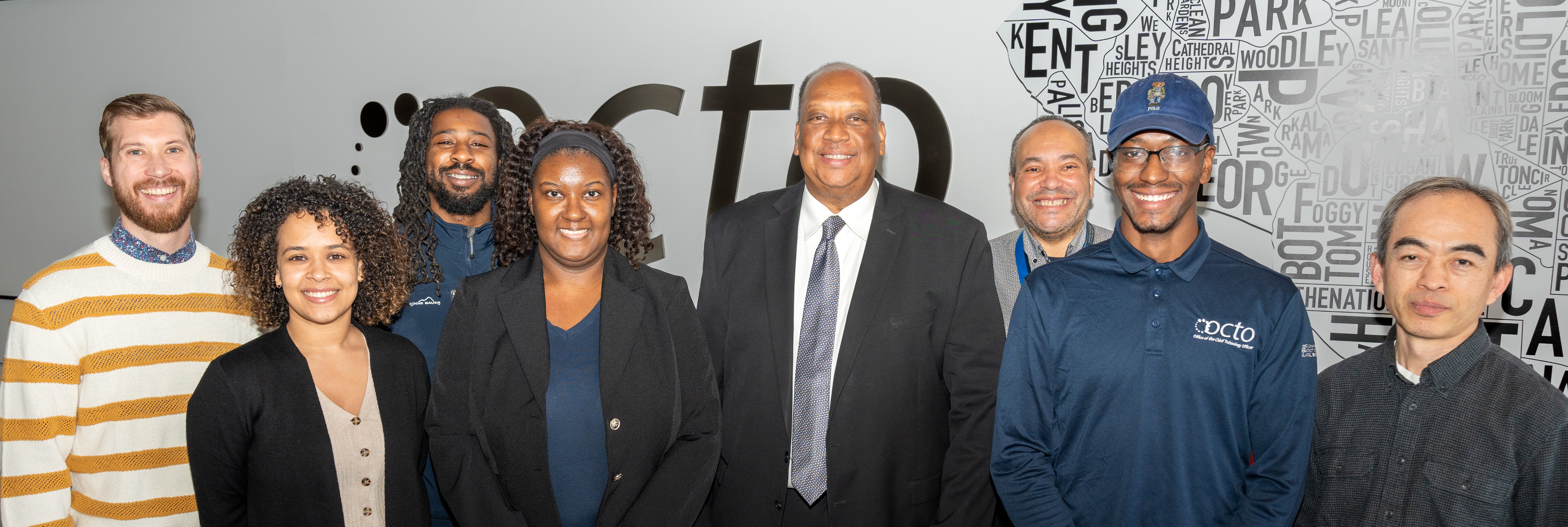
The team he leads is made up of seven individuals that Hughes says are hard-working and dedicated to the mission. “I tell my team that the work that we're doing is, whether it sounds cliché or not, to me, is noble work, as we are laser-focused on closing the digital divide in DC and truly benefitting our residents,” says Hughes.
Lay of the Land (This Land was Made for You and Me)
Without getting into the statehood debate, it is interesting to note that DC, with a population of ~700K, exceeds the number of residents in both Vermont and Wyoming and its population is comparable to a handful of other states including North Dakota and Alaska. Geographically, DC is sixty-eight square miles. Fun fact, DC was established with land donations from Maryland and Virginia.
DC is no stranger to high-tech and telecom as the capital is considered one of our country’s innovation hubs. Many technology companies are based within the District and require an availability of a digitally savvy workforce.
Hughes explains that, for DC’s broadband office, “one of our primary goals is to help provide DC residents with everything that they need to connect with the innovation that is here, enable them to compete, and ensure connectivity, devices, digital literacy, and upskilling training are all available to facilitate greater opportunities for all.”
Colonizing Broadband Before BEAD’s Statehood
While Hughes didn’t take over the DC broadband office until early 2024, he is quick to point out the many accomplishments that pre-date his arrival. Despite his modesty, success is a trend that continues under his leadership. In 2022, DC’s lead executive, Mayor Muriel Bowser established the DC State Broadband and Digital Equity Office (DC SBDEO). The stated vision then which remains today is to ensure that “every resident and every business, in every corner of DC, can live, work, and thrive in the digital age – without bias or barriers.” DC SBDEO’s achievements include:
Free, basic digital literacy training classes available to all district residents. As of last month, more than 4K District residents have received digital literacy training.
Distribution of 10,000 Chromebooks to DC residents.
Partnership with housing authorities to provide free high-speed internet access to over 700 residents via public Wi-Fi hotspots.
Administering multiple digital equity programs through the Connect DC program.
Deploying high-speed, fiber-based internet services to health, education, and social service Community Anchor Institutions (CAIs) via DC Net.
Creating the Tech Together DC program, a values-led partnership among the DC government, the nonprofit community, academia, and industries working together to bridge the digital divide through access, training, and opportunity.
ACP Dies in the Darkness
In our nation’s capital, like other areas throughout the U.S., residents need high-speed internet to be affordable to be able to obtain and maintain connectivity. To that end, one of the District’s priorities is to seek to facilitate affordable internet connectivity through its Deployment initiatives.
Way back in the early 2020’s, when ACP was still funded and was helping lower income households, DC SBDEO’s efforts included outreach to encourage those eligible to apply for ACP. The office drove a 56% adoption rate among eligible households, significantly higher than the national average.
“There was a huge need for affordable broadband, meaning that a number of residents did not have home-based connectivity, due to the cost, prior to the availability of ACP. However, under the ACP program our team helped to sign-up many residents for that program and get them connected. We are proud to have played a part in facilitating that,” explains Hughes.
Since the ACP’s funding was depleted, the DC broadband office has approached local carriers to extend discounts to ACP households, with most obliging.
BEAD’s National Treasure
As you might imagine, in a large metropolitan center like DC, the number of unserved and underserved locations is not large due to the presence of existing fiber infrastructure. As a result, a significant portion of DC’s BEAD $100.6 million award is geared more towards Non-Deployment activities (as opposed to Deployment).
DC is holding one round of funding with two phases. The first phase, prequalification, ended in March. The second phase ended last week (April 13). Applications for both infrastructure deployment AND Non-Deployment activities are being accepted in the same round.
Washington DC’s final proposal is due to the NTIA in less than a month, May 9th.
A Non-Deployment Score Ovie Would Love
“I really can’t overstate how excited I am about our office’s overall implementation of BEAD and providing connectivity to our unserved and underserved locations via our Deployments efforts, in addition to our office’s designated Non-Deployment projects and the benefits they’ll bring to DC’s residents,” says Hughes.” We conducted a needs assessment prior to applying for the grants from NTIA to uncover the District’s most pressing digital needs, and based on those findings we have tailor-made our approach to addressing the District’s broadband needs.”
DC’s approach for funding distribution will see Funds divided into three separate categories, those to operate the BEAD Deployment and Non-Deployment sub-grantee activities and related programmatic work, and a third stream of programmatic activities which will be conducted by DC SBDEO itself including:
Workforce Development – Career training to residents to enter technology and broadband fields.
Mobile Technology Fleet – Fleet will serve as “a mobile technology center on wheels” to bring financial and health services, career training, and outreach directly to District residents.
The eSports Academy – Deploy eSports gaming in D.C. public schools to help students learn software, program management, and marketing skills.
The activities mentioned above will serve as supplemental programmatic activities and services to the District. This will be in addition to activities being provided by subgrantees to benefit residents.
BEAD Non-Deployment related activities will play a significant role in DC’s overall grant rollout. As a result, it can be safely assumed that applicants within the sub-grantee selection process will seek to provide the District with a variety of allowable programmatic activities, including the list of some examples below:
Digital safety/cybersecurity training
Remote learning and/or telehealth services and facilities
Career training for computer science, coding, and cybersecurity.
Direct household broadband subsidies
“Ultimately, broadband is great on its own, but without people using it, it's meaningless,” says Hughes. “We’re working hard to ensure that connection has tangible benefits so that our citizens adopt and leverage broadband.”
Life’s a Beach… Until it Isn’t
Though he’s spent his entire life in the Eastern time zone, that’s where the similarities of Kevin’s previous residences end. Kevin originally hails from St. Thomas, U.S. Virgin Islands and has strong family ties to Washington DC and New York, spending time in both cities growing up.
Upon graduation from Lehman College, Hughes spent several years in New York working within the telecom industry. Eventually, his journey would lead him back home to the USVI where he transitioned specifically to the broadband industry, working with viNGN, a BTOP awardee, overseeing more than $60 million in federal grant funding, and oversaw the PCC, SBA, and SBI federal grants. This included opening thirty-three public computer centers, distributing laptops to residents, providing free career-level programs enabling island residents to obtain telework employment. Additionally, Hughes co-led on the implementation/installation of the fiber-optic ring deployment across the USVI, providing gigabit bandwidth speeds to all CAIs.
Author’s Note: I’ve been on vacation in the US Virgin Islands… I know people who live in the USVI currently. What I can’t wrap my head around is LEAVING the USVI unless the opportunity was simply too good to pass up.
Mr. Hughes Goes to Washington
With his passion for broadband and a servant leadership philosophy, Hughes could not pass up the opportunity to join NTIA in 2021 to serve as the Team Lead, Connecting Minority Communities Pilot Program (CMC). Under his leadership and oversight, he awarded $268 Million in funding to 93 awardees representing HBCUs, TCUss, and MSIs nationwide.
With his work completed in March of 2024, one would think he and his family would return to the USVI. Nope, it was then when he took over DC’s broadband office. “It was an easy decision to take the administrator position, as not only am I familiar with DC, I love it. And the opportunity to serve and really make a difference here within our nation’s capital, moving from the federal side over to the local side, was a great opportunity for me.”
Cherry Blossoms are in Bloom for the Hughes Family
Kevin and his wife are empty nesters in DC. Their two grown sons are following in Dad’s footsteps. No, not in broadband but rather filmmaking and television. Hughes started his career with MTV, A&E, Comedy Central and more in New York before heading back to the USVI in 2003.
“I've spent some time working in sales and selling widgets, which is great money, but it can leave you feeling a bit empty. The job that I have right now is fulfilling, as I work with a great team at OCTO and DC SBDEO, giving me the opportunity to help others by providing them with access to high-speed internet, connect them to the broadband eco-system, and facilitate twenty-first century opportunities for them,” says Hughes. “I’ll sometimes get in my car and drive throughout the district, interact with the people, and envision the grants we’re allocating making a significant difference in their lives. That’s what’s rewarding, much more so than sales commissions.”