2025 State Broadband Director Survey
Crystal Balls, BEAD, Trump, and 2025
When we decided that yes, even we can be susceptible to presenting a “next year lookahead piece.” It’s low-hanging fruit but given the fact that there will be a new administration on January 20th, we wanted to examine what changes might be in the offing and potential changes that might be concerning. So we went right to our best source, state broadband directors, for predictions. Admittedly, many question their own ability to predict just what “might” happen, but we asked, and 31 state directors answered.
New Administration, New BEAD?
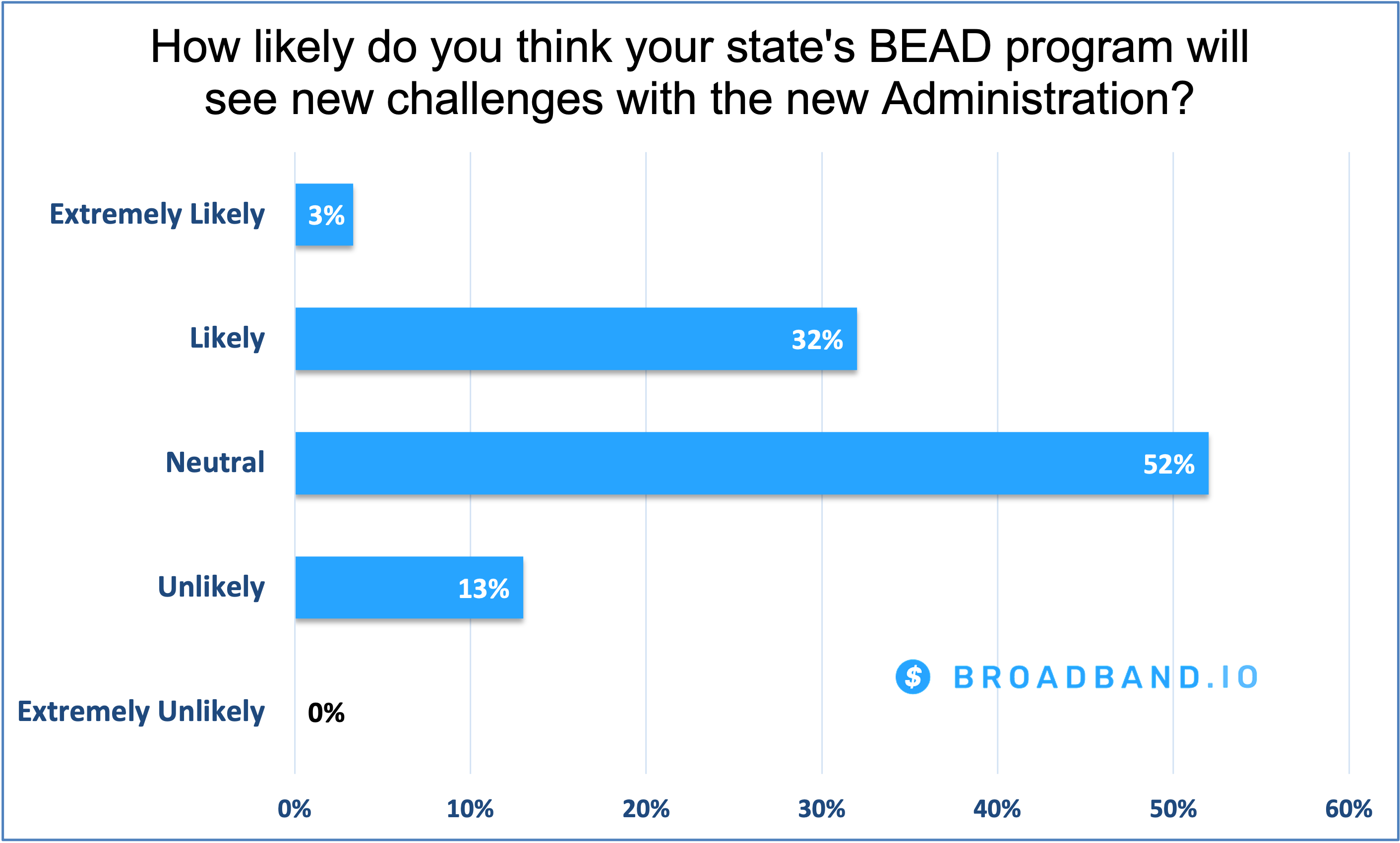
A third (35%) of state broadband directors forecast that it is likely the BEAD program will experience new challenges with the incoming administration. That’s probably a nice way of saying, ‘oh boy…here come unwelcome changes.’ Conversely, a small number, 13% (3 of 31 surveyed) say new challenges are unlikely while just over half are unsure and not prepared to guess.
Reply Hazy, Ask Again Later
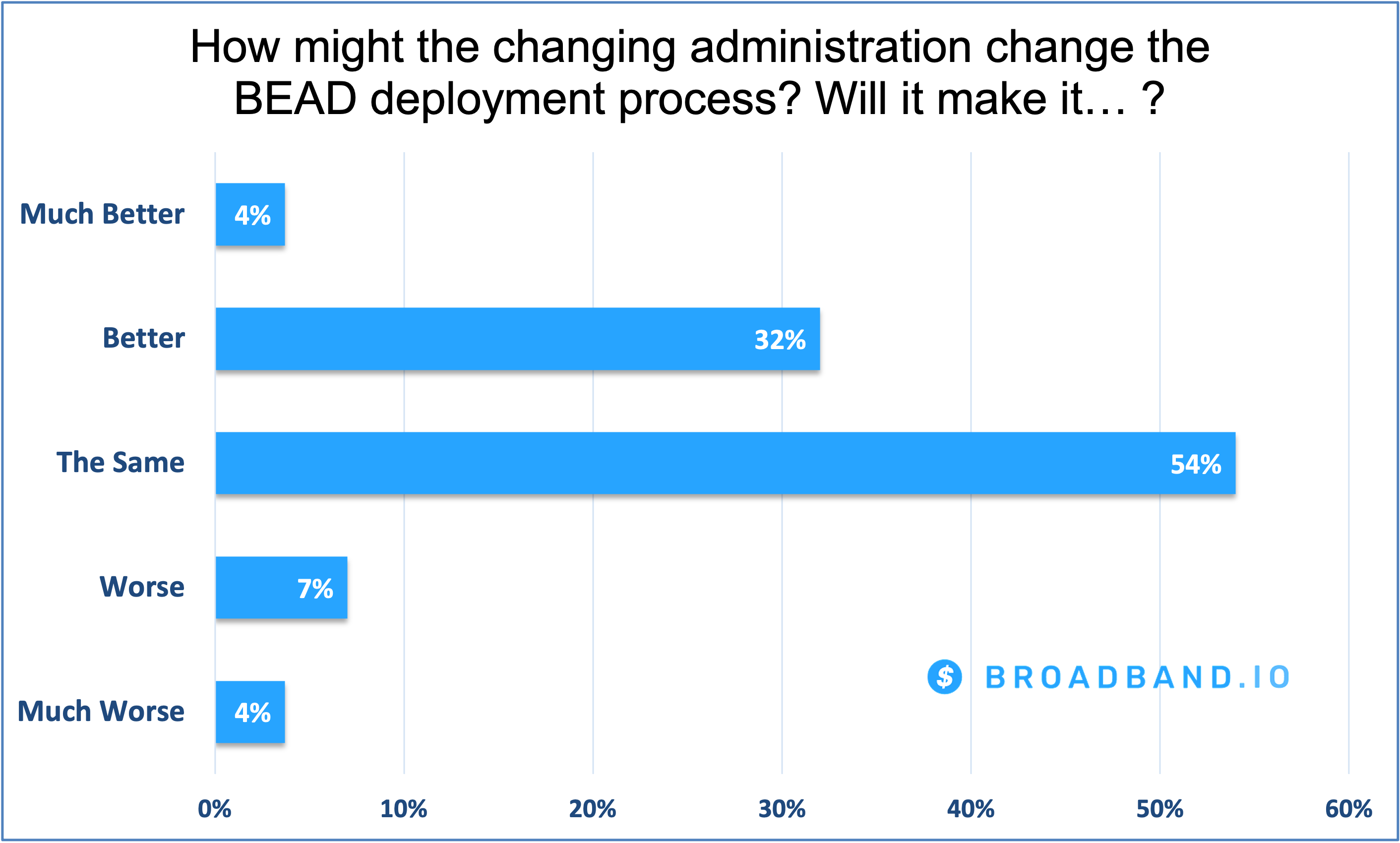
When we asked state directors to assume that there will be changes with the upcoming administration, approximately the same number shook their Magic 8 Balls and thought that the BEAD program will be the same, regardless of administration. Only 11% (3 state directors) are predicting that changes will make the program “worse” while more than a third (36%) are looking forward to positive changes in BEAD that might accompany the new administration.
Pardon Me… What’s the Problem?
Moving on to the program itself, we asked state directors to predict what challenges are most likely to impact BEAD deployment in his/her respective state.
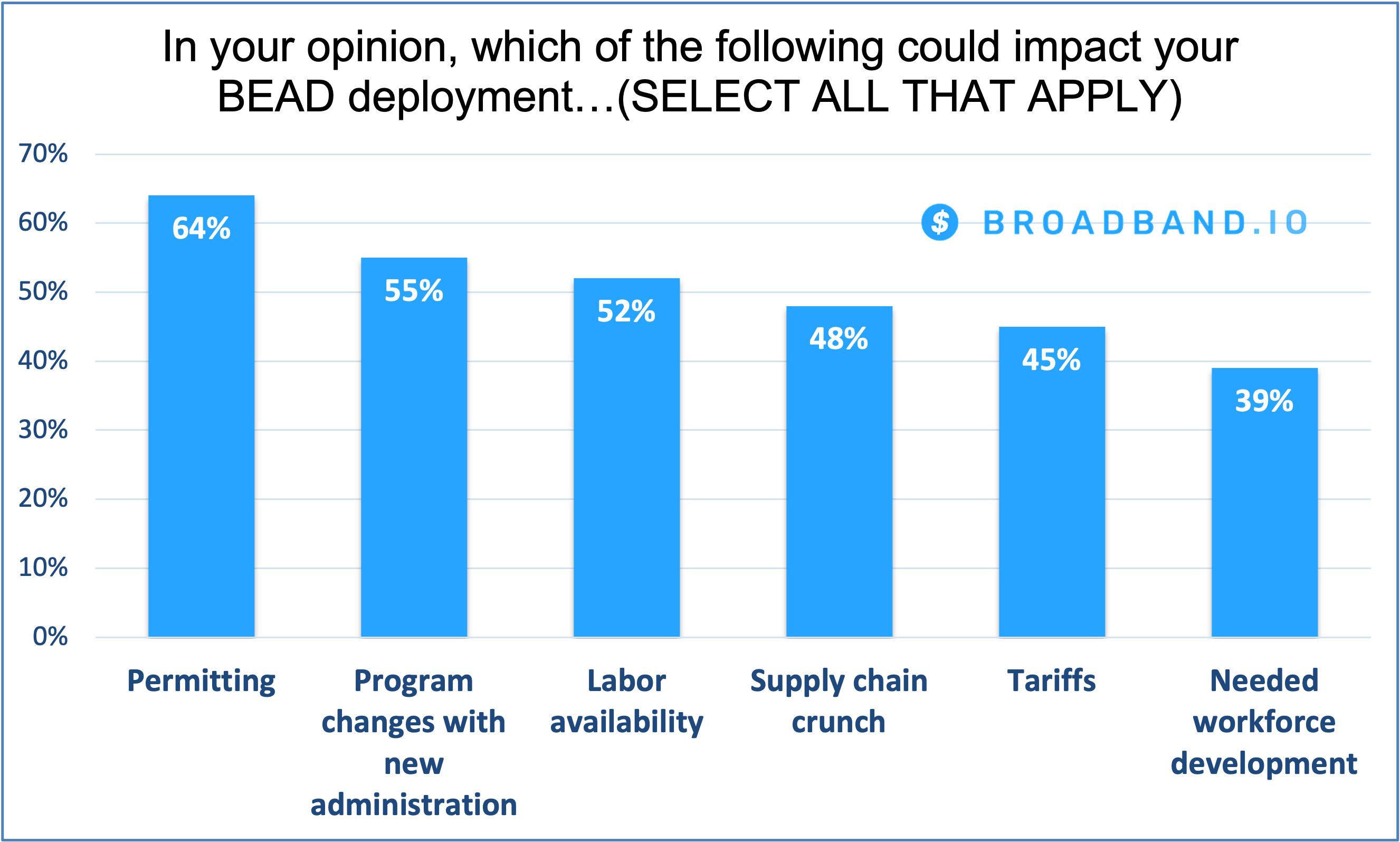
Both potential changes with the new administration (55%) and the possible tariffs (45%) that could accompany the country’s new leadership are concerns of approximately half of broadband directors. But far and away the biggest concern is permitting challenges, both state and federal (federal lands). Of course, all states aren’t created equal, and some states have more significant challenges in this area than others.
Two challenges, labor availability (52%) and a potential supply chain crunch (48%) worry state directors who, quite frankly, have little influence over either potential challenge.
Conversely, state directors can have an influence on workforce development needs. Perhaps that’s why less than half (39%) are concerned about a workforce ready to deploy network builds. For several states, nondeployment funds are being used for training to overcome this very issue.
Wait… How Long?
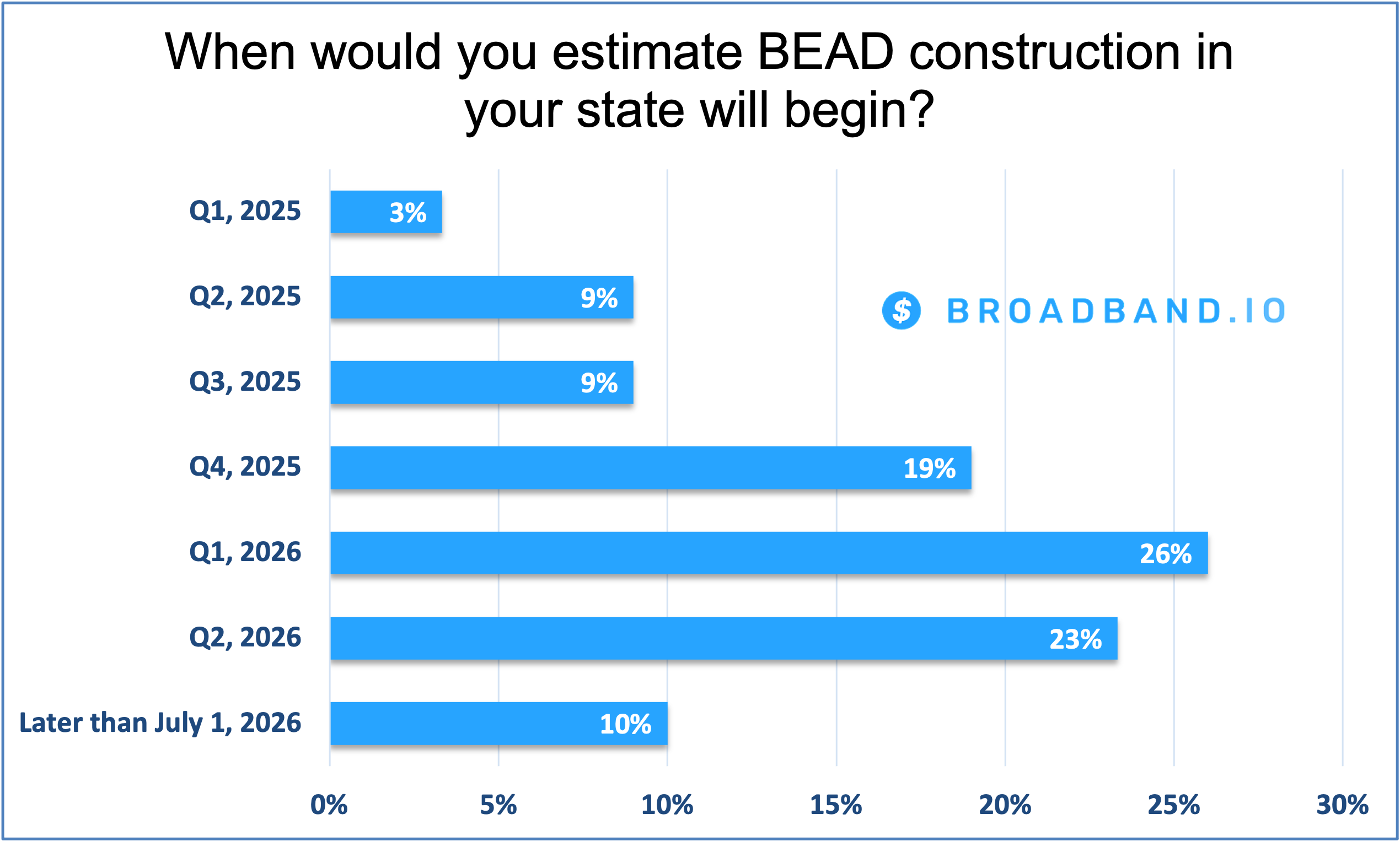
Only 2 in 5 (40%) plan to start construction in 2025, which makes me wonder if some critics of BEAD might have a point when criticizing the program. Regardless, onward!
Who’s that Guy with the new/old President?
You’ve undoubtedly noticed that wherever Donald Trump goes, so too does Elon Musk, Starlink’s founder. This might make folks apprehensive as to whether fiber money might end up being diverted to Trump’s right-hand man and his LEOs.
Instead of speculating or playing a guessing game, we asked directors if a possible diversion in funding to LEO (Starlink) worried them. And much like almost everything in American politics, there was no consensus.
Are you concerned that there may be a change in BEAD program priority from fiber to LEO (low earth orbit) satellite with the new Administration? Please explain.
“With the new administration's clear orientation towards cost reduction and interest in LEO technologies, it seems very likely.”
“We are concerned, yes. Fiber deployment is the most reliable technology, future proof, and provides the most benefit and value.”
“I hope that we will continue to prioritize fiber and will do everything in my power to keep that priority.”
“I could see the new administration taking away the flexibility states have to make determinations on LEO vs. fiber.”
“No. States are running their own programs, LEO may be needed where fiber doesn't make economic sense, but there isn't enough LEO capacity to cover every location.”
“New mandates from the NTIA would be counter to the overall anti-regulatory message of the incoming administration.”
“I wouldn't say I am concerned. The BEAD program has faced its issues, but states are nearing the point of activating. There is going to be a lot of good work done with the funding available and fiber is still the best technology available today.”
“No satellite network currently has the capacity to support all the unserved and underserved customers.”
Final Insights from Directors’ Crystal Balls
We’d like to acknowledge that this wouldn’t have been possible without the cooperation of some very busy, but very cooperative state broadband leaders. Thank you all!
Many directors are optimistic that the new administration will help remove regulatory barriers and allow for states to get on to the point of the program – connecting citizens!
Please spend a minute to forecast the changes in the BEAD program that will accompany the change in administration.
“If anything, we would expect new guidance which would possibly streamline regulatory guidance on things like NEPA permitting and labor rules.”
“Clarification/guidance/deregulation of certain programmatic requirements, particularly those surrounding administrative requirements.”
“Our hope is Congress will continue to protect this important program.”
“I fear that the new administration will punish blue states. I also wouldn’t be surprising to see certain requirements waived, namely NEPA.”
Probably few. Probably more responsive to the states and hopefully they will approve things swiftly, which would be a total 180 from the current administration.
“I believe the new administration will remove several requirements that makes the BEAD program difficult for states and ISPs to implement, i.e. labor, BABA, environmental, and historic preservation requirements.”
“Possible less NTIA compliance and micromanagement of states, including relaxing some of the over prescribed rules. Hopefully more flexibility for states to do what is best for their state.”
“I am hopeful that we see changes that streamline the processes. The BEAD program was intended to be the federal government funding states to address their needs. Over time it became very federally driven. This has led to major delays in the program. There are many ways in which power could be handed to the states and still have a successful program.”
“The incoming administration has stated that they want less of a role for the federal government and a greater role for states. If this is truly implemented, with less oversight and downward regulation and more state independence, then I can see some benefits to the program such as reduced permitting burdens, less NTIA pressure, and states being able to chart their own course for BEAD.”
Happy New Year and thank you for your support and spending time on broadband.io. Here’s hoping that 2025 is a great one for you and yours and also that our underserved and unserved receive the broadband connections they need!