Commonwealth of the Northern Mariana Islands on Track to Actually Realize Universal Coverage
The Commonwealth of the Northern Mariana Islands (CNMI) is 183.5 square miles, which, for reference, is approximately half the size of Rhode Island and twice that of the US Virgin Islands. The islands are home to ~55K people, or 7% of our least populous state, Wyoming.
As all Northern Marianans are American citizens (whether or not you’re familiar with CNMI), the island is a recipient of BEAD dollars. And it is the only recipient to designate 100% fiber to subgrantees.
Though the archipelago is made up of 14 islands, most CNMI residents live on one of three: Saipan, Tinian, and Rota. CNMI voted to become part of the United States in 1975 with 80% in favor.
I spoke with an extremely upbeat Glen Hunter, CNMI’s broadband director, and it’s hard not to ‘catch’ his enthusiasm. “Getting the island universally connected should happen within the next few years, far in advance of what I ever thought was possible.”
Hunter describes CNMI as extremely beautiful offering white sandy beaches, palm trees, and a lush jungle environment. Resorts, golf courses, and world-class diving.
“Our number one economy is tourism. In fact, our only economy is tourism. We’re heavily reliant on Asian tourists. We're about a three-hour flight from Japan,” says Hunter.
Red-Headed Stepchild?
While aspirations are high, Hunter tells me that in no way are the territories treated as equitable to the states. “Because we're a US territory and we're not specifically a state, it really affects us on a bunch of levels.”
He tells me about all the ways that funding is shared amongst the territories versus receiving the state-mandated funding minimums of $5M for planning and $100M for the actual program.
His ultimate wish is that the federal government would stop treating the territories like a red-headed stepchild. ‘Lesser than.’
For CNMI, BOB was No Biggie
In all, the island only has 5% connected to broadband, 500 of 10K BSLs. As such, CNMI received $81M in BEAD funding. Post-BOB, CNMI will still be able to connect ~9.5K BSLs to fiber for a price of ~$31M.
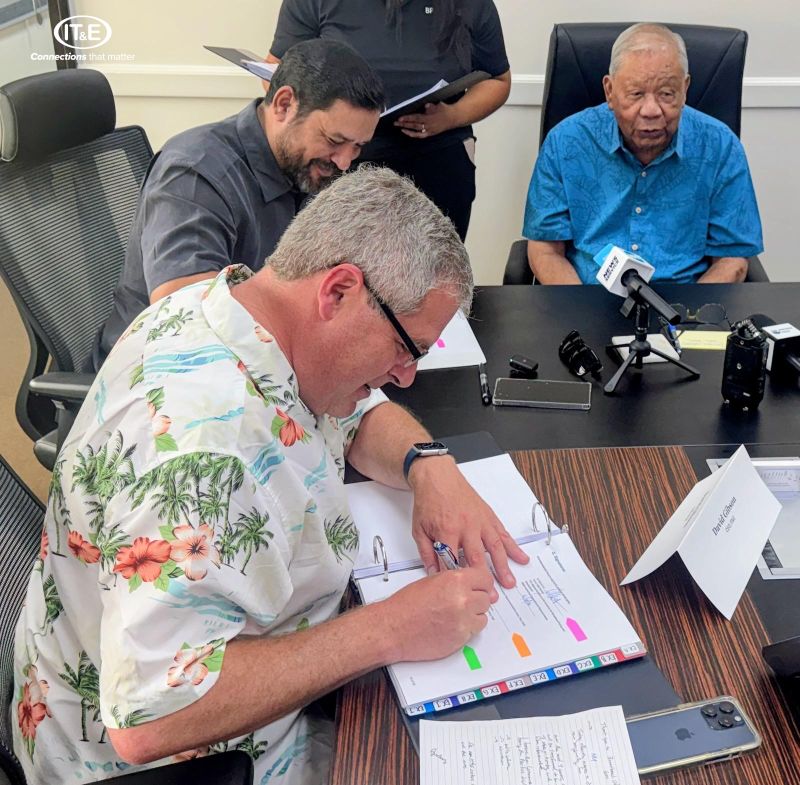
Hunter reports that CNMI subgrant process was competitive and received three underground fiber-only applications. Per new guidance, selecting solely on price, Micronesian Telecommunications Corp. (DBA IT&E) won all twenty project areas. Currently, IT&E provides internet service with speeds well below required broadband speed minimums via DSL.
IT&E is pitching in ~$21M in matching dollars to build the all-fiber network, holding the cost per passing for underground fiber to ~$3,278, well below the NTIA’s ‘65% Excessive Cost Threshold.’
“Looking at our broadband mapping, our areas are all condensed,” says Hunter. “There are not really extremely remote locations, so getting fiber to all BSLs is possible for all of them.”
Priority Broadband is a Priority in CNMI
Hunter tells me that because the islands are centered in the Pacific’s ‘typhoon alley,’ CNMI’s beautiful, pristine environment gets disrupted yearly with “three to fifteen pretty massive storms that come right through our waters and across our islands.”
High winds make an underground infrastructure a must on CNMI, limiting connectivity builds to fiber. Hunter rightfully points out that “no one is investing in copper in 2026.”
So, he explains, there were parameters that limited technology options. “I couldn’t care less what the technology is from a broadband perspective. Just prove to me that you can give me the speed that is broadband; find a way to make sure that it can survive a 200-mph sustained windstorm.”
As far as resilience and reliability, Underground deployment on these islands has already been proven. All the conduit that currently houses all the existing, archaic DSL and telephone lines is underground and has been stable through decades of past storms. These buried landlines have survived the storms, ‘but as we know nobody uses landlines anymore.’
Hunter tells me that even prior to June 6th, his office was messaging to the NTIA that underground connectivity was a must. “We didn't want to put federal dollars into something that the next storm comes around and the whole system is wiped out.”
Hunter tells stories of the electrical grid, cell phone infrastructure, and cable TV all being down for months at a time. “When the NTIA visited, they saw the aftermath of a big typhoon, including spools of wire all over the place, telephone poles that were literally snapped in two.
“We needed to show, not tell, the NTIA what life in the CNMI is like with all these weather interruptions,” says Hunter. “A lot of America doesn't know who we [CNMI] are, including NTIA staff, so we asked for and were granted an NTIA visit. And we’re so thankful they see our challenges and are helping us get needed infrastructure.”
From Island Time to Internet Time
Being reliant on tourism, Hunter tells me, has been economically tough on the CNMI in the past decade or so given the pandemic and the economy. In fact, tourism numbers are at an all-time low.
“Our government budgets are strained; it's just been really difficult,” says Hunter. “It is why this program was so important to our governor when he took office three and a half years ago, setting up the broadband office. We absolutely need federal funding to do something where local funds aren’t available. The main goal was to diversify our economy and establish a digital economy here.”
Hunter credits the since-deceased governor Arnold Palacios with having a vision that CNMI’s destiny would be to become a power player in the digital world. “We sat down together, the governor and our team, to set up a digital economy and diversify so all our eggs aren't in the tourism basket.” Palacios’ successor, Governor Apatang, has been equally as passionate about this digital endeavor.
Hunter sees CNMI’s future fueled by becoming ‘fertile ground’ for digital development. “We'll be one of the only areas in America with 100% underground, reliable fiber as well as a planned Pacific network hardening so we could become an area where people (hopefully) come.”
Hunter sees fiber as the backbone for the islands to develop a variety of tech-based opportunities, including data storage facilities, chip manufacturing plants, and nomadic Asian tech professionals looking for a home. All on a piece of US soil that has the lowest tax burden in the US.
“I think we could really become a digital hub for the Pacific as well as this part of the world,” extols Hunter.
Hunter expects construction to start, ‘worst case,’ at the beginning of 2027, with the build spanning two to three years.
He’s hopeful that the ~$50M due to the CNMI in non-deployment funds can be used to help train a workforce in the digital world versus just tourism. Also, on his wish list would be investing a good deal of it in cybersecurity.”
Casting a Broadband Lifeline
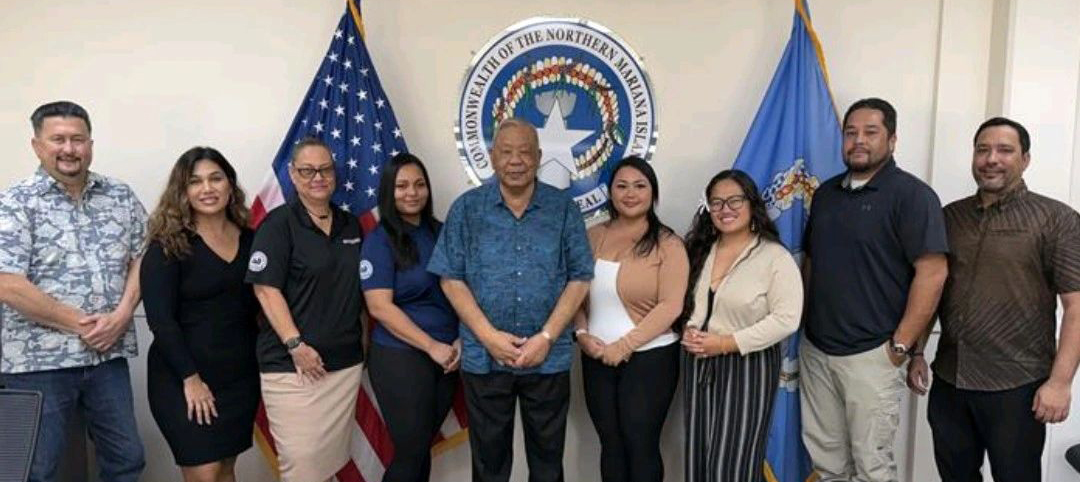
Recalling his start at the CNMI broadband office, Hunter tells me that it started with him in early ’23 and has grown into a staff of nine.
He describes the team as tight-knit, dedicated and passionate to get the BEAD program through and fit it within the islands’ greater infrastructure. “This is transformational. We are going from maybe 5% connected homes to 100% within two or three years. The motivating factor for all of us is that we really believe we can become a fertile ground for digital development.”
Hunter says he has been labeled an ‘activist,’ passionate about how he can speak up, act, and make a wrong a right. He’s looking to bridge the digital gap in CNMI and, with it, overcome past connectivity challenges.
“With the new fiber infrastructure, CNMI will have a pathway to economic opportunity for citizens and hopefully foster an entrepreneurial spirit on the islands,” says Hunter. “Our community is unaware of the opportunities because we've been in the dark ages of connectivity for so long. We’ll be sure not to overlook our local community and give them the knowledge and digital resources they need to take advantage of this new connection.”
Having also spent time residing in Hawaii and Florida, Glen has lived in the CNMI for nearly five decades.
Views expressed are the author’s own and do not necessarily represent the official position of broadband.io or its affiliates. Contact Doug Adams at doug@broadbandmarketers.com with any comments or questions.