No Island is an Island: Guam’s Push to Connect Everyone
The other day, I spoke with Melissa Bettis, Guam’s broadband director, who was already living in my tomorrow. Naturally, I asked whether the future was looking any better. She explained, that is not how time zones work.
Bettis and her team are working on connecting Guam through BEAD. She defines this as ‘a better future—one with reliable internet connections, stronger infrastructure, and fewer people left offline when the weather turns.’
Guam is home to the Indigenous CHamoru people and a diverse community of ~155K that includes residents of Filipino and other Asian backgrounds, fellow Pacific Islanders, and military families. For this American island in the western Pacific, staying connected means bridging both service gaps and considerable distance.
Guam, Where America’s Broadband Day Begins
Fun fact: Guam, along with the Mariana Islands, is the furthest US territory west on the date line.
Guam established its Office of Infrastructure Policy and Development, or OIPD, in 2022, which also serves as Guam’s broadband office. Bettis took the reins in 2023.
Our conversation came shortly after Super Typhoon Champi passed close to Guam. Bettis described going roughly two days without electricity – a reminder that reliable broadband depends on reliable power, too. It’s the third typhoon to hit Guam this year, making boarding up windows commonplace on the island.
A quick weather clarification: hurricanes and typhoons are the same type of storm. The name depends on location. In the western North Pacific, they are typhoons; in the Atlantic and central and eastern North Pacific, they are hurricanes. The wind does not care what is printed on the label.
For Bettis and her small team, these disruptions make their mission personal.
“We’re lucky to have a team passionate about improving lives in Guam generally and also specifically with telecommunications,” she says. “Each and every staff member is very passionate about making sure that everyone has connectivity.”
The team brings experience in government program management, a useful skill set when the work involves coordinating providers, managing grants, navigating federal requirements, and turning plans into actual connections.
Rock You Like a Typhoon
Guam received a particularly forceful lesson in broadband resilience when Typhoon Mawar struck in May 2023. Mawar was a Category 4 typhoon with estimated sustained winds of 140 mph as it reached northern Guam on May 24. It caused extensive damage and disrupted essential services across the island.
Telecommunications restoration became a prolonged undertaking. Months after the storm, Docomo Pacific was still mobilizing additional technicians, construction crews, and equipment to restore its network.
For Bettis, recovery also presented an opportunity to rethink how infrastructure was built.
“There was really a big push to get everything built back, but better,” explains Bettis. “Prior to Mawar, we didn't have much residential fiber at all. After the typhoon, carriers built hardened, more resilient internet service.”
That means looking beyond speed alone. A fast connection is valuable; a connection that can better withstand a storm, recover quickly, and support emergency communications is more valuable still.
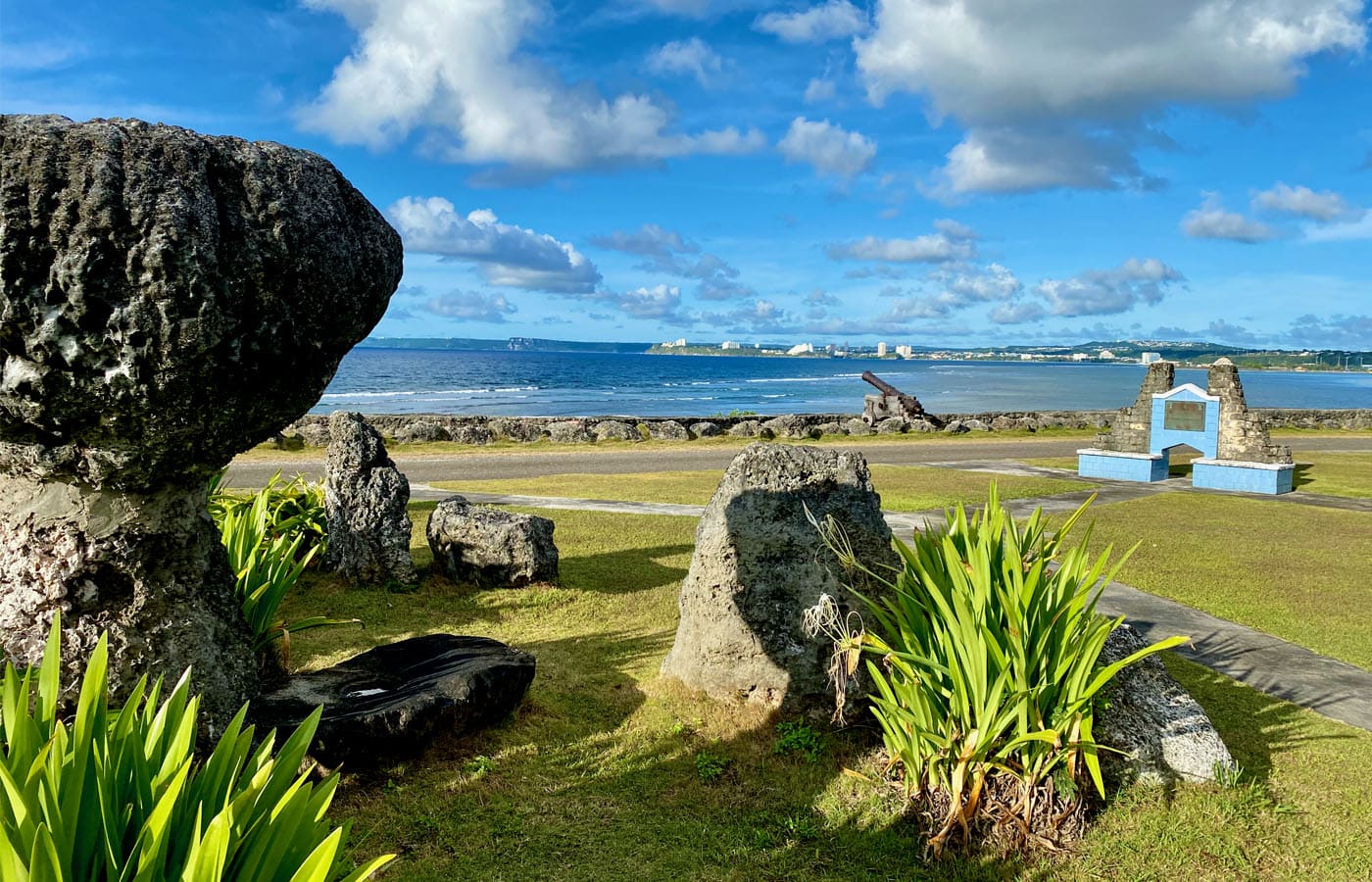
Beachfront BEAD
About a month after Mawar, in June of ’23, Guam was informed that its BEAD allocation would be ~$157M.
BEAD joined investments already underway, including ~$30M in USDA ReConnect to expand broadband access to 16K BSLs, primarily in southern Guam. Together with providers’ own network investments, these projects help explain why Guam’s remaining BEAD deployment needs are much smaller than its overall allocation might suggest.
Guam’s November 2025 deployment announcement described plans to bring fiber to nearly 1,400 homes and connect 175 community anchor institutions. The same announcement identified approximately $1.82 million in federal deployment subgrants and $3.13 million in provider matching funds—roughly $5 million combined.
Bettis says the emphasis is on resilient fiber, with underground construction where feasible to reduce exposure to damaging winds and other potential natural and manmade hazards.
Satellite service also has a place in Guam’s connectivity mix, particularly when storms disrupt land-based networks. But availability is only part of the equation.
“I think it’s a matter of affordability at this point for anybody that doesn’t have the service,” Bettis says. A connection can reach your neighborhood and still be out of reach for your household budget.
Big Plans, Pending Non-Deployment Permission
With deployment awards accounting for a relatively small portion of Guam’s allocation, Bettis anticipates a substantial remaining balance—potentially more than $130 million, subject to final program costs and federal decisions about allowable uses.
Bettis says Guam has already gathered community input and developed ideas for addressing broader infrastructure needs. Further work on non-deployment initiatives remains dependent on federal guidance and permission to proceed.
Priorities include strengthening broadband infrastructure, hardening the power systems that keep communications running, making public services easier to access online, as well as workforce development.
For residents, the benefits could be decidedly practical: fewer trips between government offices, less time spent tracking down forms, and more services available without having to rearrange a workday.
Small Island, Extended Family
For Americans who have never visited Guam, it can be easy to picture a distant dot on a map. Bettis describes a close-knit community “where relationships run deep and family connections have a way of surprising you.”
She laughs about DNA testing revealing relatives that Guam residents never realized they had. “You know, on the island, when you know somebody, you don’t just know them, you know their entire family, extended family, etc.”
Bettis says that family gatherings, village celebrations, shared meals, and looking out for neighbors are part of that sense of belonging. “The scenery may draw visitors, but the people make Guam home.”
She says that this helps explain why connectivity matters so much to Guam. “It connects students to classes, patients to care, businesses to customers, and families to loved ones thousands of miles away.”
On an island, connection has always mattered. Increasingly, it needs to be dependable.
Bettis’ Route Home
Born and raised in Guam, Bettis spent approximately two decades on the mainland, primarily in Arizona, with time in Washington, D.C.
At the Maricopa Association of Governments, the regional planning organization for the Phoenix metropolitan area, she worked on public policy and regional coordination involving transportation, air and water quality, and services addressing homelessness.
Bettis eventually returned to Guam to be closer to family, particularly her elderly grandmother.
Today, she has four adult children, with family ties stretching between Guam and the mainland. At home, her household includes her husband and Ajax, a shih-tzu–poodle mix whose responsibilities, presumably, do not include federal grant reporting.
Her work brings together the two places she knows well: government programs and island life.
She may not be able to tell the rest of us what tomorrow (my today) holds. But she is working to make sure Guam has a better connection when it arrives.
Views expressed are the author’s own and do not necessarily represent the official position of broadband.io or its affiliates. Contact Doug Adams at doug@broadbandmarketers.com with any comments or questions.