Virginia is For Broadband Lovers
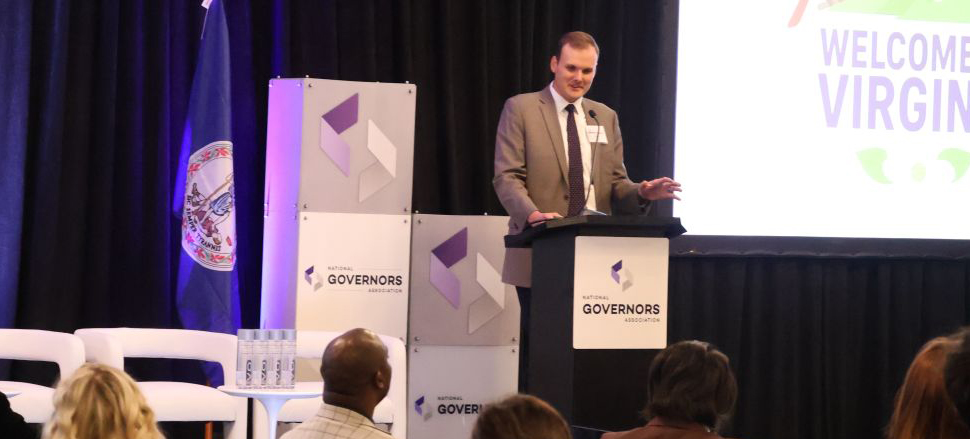
I finally caught up with Virginia for a profile the other day, a state commonwealth that’s been the center of the BEAD drama and a leader in broadband deployment. Newly minted Virginia Broadband Director Chandler Vaughan took some time last week to catch me up.
My experience with Chandler is that he is always upbeat and enthusiastic. He credits the fact that he isn’t in a stale, ‘white bread government job.’ He tells me he thrives in the job because it is ‘entrepreneurial and fast paced.’ “We’re not just another administrator; we can actually see the work happening in communities.
Fun fact kids, Virginia is often called the ‘Internet Capital’ because a massive share of the world's internet traffic flows through data centers in Northern Virginia's Loudoun County. No commentary on this controversy, just reporting a fact.
Historically, Virginia is Not Cavalier About Broadband Investment
Virginia’s broadband office opened in 2017 with a $1M allocation for the creation of a broadband deployment program to supplement private sector broadband construction costs.
Since then, under the helm of Dr. Tamarah Holmes (who is now promoted to the Director of the Virginia Department of Housing and Community Development, which oversees broadband), and prior to BEAD, the Virginia Telecommunication Initiative (VATI) has allocated approximately $950 million ($700 million ARPA and $250 million state general fund) to connect ~400K locations with mostly fiber.
What About BOB and the “True Up”?
Before actually receiving his state’s ‘true-up’ number of unserved BSLs that will be added to the BEAD equation, Vaughan estimates that list will include approximately 40K BSLs. The new locations will account for up to an additional $256M (cost per location being $6,409). This investment would be on top of the original BOB/BEAD allocation of $545M. At this point non-deployment funding would still net out to $680M before administrative funds are accounted for.
Vaughan forecasts different technology results within the “True Up” round, mostly because of the limitation to meet the average cost per location with newly named unserved BSLs. “If you had fifty percent LEO in round one, you're probably going to have sixty five percent LEO this round. We estimate that these locations will be scattered among existing deployments and be mostly a competition between short haul fiber extensions and, outside of a potential Fixed Wireless proposal, LEO picking up additional locations where the technology works well and where locations don’t make sense economically for other providers.”
For his part, Vaughan sympathizes with the NTIA’s task of coming up with the correct BSL count for the new round. “Right now, they are going through fifty-six different file data sets and cases to make judgment calls on to add to the map.”
He emphasizes that the numbers must include location defaults from other programs that were defaulted on. This would hopefully include the RDOF locations that have not been ‘officially’ defaulted on, but the ’writing is on the wall’ Vaughan emphasizes that “it is more important to get this location list with NTIA right than get it fast.”
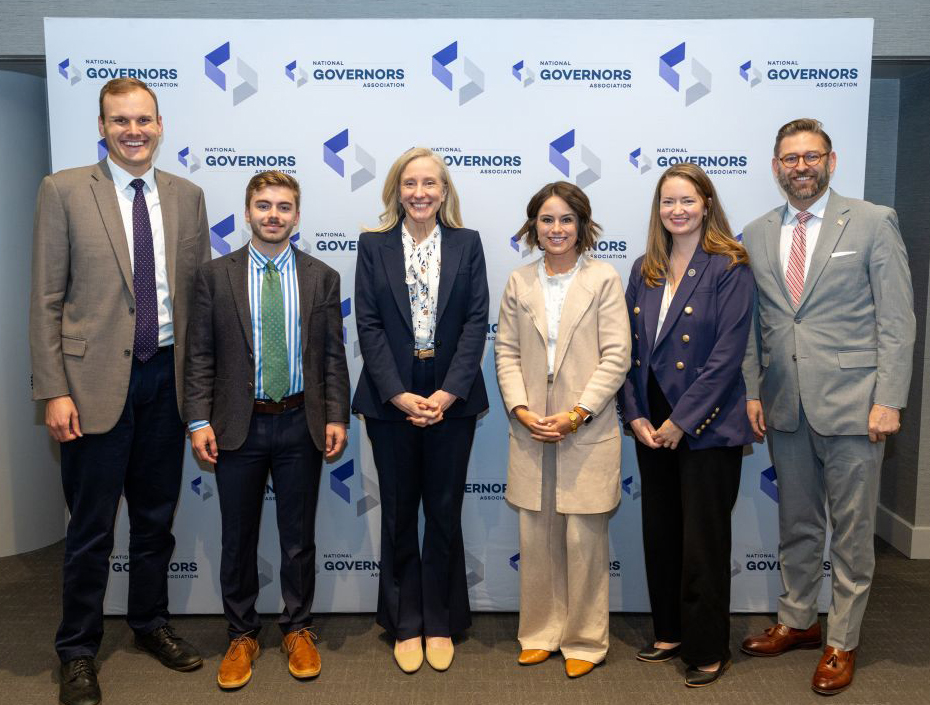
Left to right: Chandler Vaughan; Cole McAndrew, former VA broadband office employee, Governor Abigail Spanberger; Caroline Luxhoj, Broadband Deployment Grants Manager, Cass Rasnick, COO of DHCD; and Brandon Tatum, CEO of NGA
Salvaging BEAD Fiber with Priority Broadband
Vaughan reflects that when the June 6 (2025) NTIA BOB guidance came down, every state was ‘scrambling.’ “It was an exercise in how do states organize themselves, take a new policy priority at the federal level, and still deliver good results on the ground.”
Assigning application areas with ‘priority’ status, Vaughan, the GIS team (Lonnie Hamilton), and a group from an upstart geospatial analysis firm, ‘Stelonic’, took the time to dive deep into the US Forest Service data set to better reveal where tree cover and other factors may impact technology performance.
Within each project area (zip code), Virginia examined the data set’s 30-meter by 30-meter granularity and aligned it to corresponding BSLs’ rooftops.
“We know the broadband maps and the geospatial analyses in our state better than anybody,” says Vaughan. “And we took that knowledge along with the Forest Service data to identify areas where LEO and other technologies would not be a priority solution.”
Every one of Virginia’s 1,200 zip codes was measured by criteria including the degree of slope variation, the percentage of tree canopy coverage, population density, etc. The same criteria were used to designate wireless and fiber. A project area with more than a given tree canopy coverage wasn’t eligible for LEO. Obviously, both tree canopy and slope also impacted possible wireless deployment. Fiber feasibility was measured by cost.
Vaughan is quick to tell me that this was/is within the bounds of the June 6th policy notice. And Virginia shared its methodology with others.
The Priority Broadband Fallout
In August of last year, SpaceX issued a seven-page complaint/comment stating that Virginia ignored the guidelines of “benefit of the bargain.” Starlink accused Virginia of “disregarding the Trump Administration’s effort to restructure the program to accelerate broadband deployment and reduce spending.”
The 10% assigned to LEO in Virginia clearly wasn’t what SpaceX expected and/or hoped for. Its complaint claimed that SpaceX is claiming that Virginia’s “Final Proposal is a manufactured outcome that is incompatible with the law and results in grossly wasteful and unnecessary costs to the taxpayer,” and insisted that “Virginia must immediately revise its final proposal to appropriately consider applications received in line with program rules. Alternatively, NTIA must deny Virginia’s final proposal.”
The first to submit its final proposal, Virginia served as a ‘canary in a coal mine’ of sorts to test the priority broadband hypothesis. Virginia presented its methodology to the NTIA. Its Final Proposal was ultimately approved after negotiations with NTIA on project cost.
“This is a case study of how states came together, through individual meetings, group calls, etc. to strategize how to navigate this policy change,” says Vaughan. “When the rules come out and there was still a priority broadband designation, we saw how we could meet the intent of the new guidance but still produce good results on the ground.”
The state’s final proposal was to connect with ~$545M. Virginia’s methodology yielded a final proposal with 80% fiber (~68K), HFC with 5.8%, wireless at 1.5%, and LEO at ~13%. Vaughan says the LEO number is about 3% higher than Virginia initially submitted, but is happy with the outcome after cost negotiations with NTIA.
“Listen, I have Starlink myself for tailgating at Virginia Tech football games,” recounts Vaughan. “It’s a great technology, but I know what conditions it works well in and what conditions it doesn't work well in. So yeah, tree canopy matters, topography matters.”
Non-deployment, Not Baby, is in a Corner
That ~$545M number ($936M minus BOB 2) could certainly have a significant impact on broadband-related programs and activities in the commonwealth.
And Vaughan tells me that many on his staff have a deep desire to keep contributing to the Commonwealth’s broadband future.
“We’re really interested in building on the momentum of broadband deployment. We’ve brought entire counties online over the last few years under state programs. The team doesn’t want to see communities stop once they reach universal coverage. They should look to the next steps with it,” says Vaughan. “There remains real hope that non-deployment funds would be key in funding these programs… but now, we’ll see,” says Vaughan.
Other than telehealth, Vaughan tells me that there’s significant need to invest in better rural cell service in the Commonwealth (to the tune of 40,000 homes and 10,000 road miles that he says are in complete dead zones with no coverage). He’d also like to put non-deployment money behind better connections for MDUs in low-income apartment buildings currently living with 10/1 Mbps service. Finally, and only off the top of his head, Vaughan tells me that other areas for investment could include disaster/emergency relief and preparedness, precision agriculture, digital literacy, workforce development, and AI readiness.
Virginia Is for Completers
“If non-deployment sticks around, hopefully there's something there, career-wise,” says Vaughan. “But I've been transparent with our people that if we do our jobs well, we're going to work our way into nonemployment.”
Theoretically, Vaughan muses that “We can go through iterations of updates to the national broadband map for the next 20 years, but at some point, we're just going have to claim victory and say ninety-eight or ninety-nine percent of known coverage, plus the availability of LEO, is universal coverage.”
Pragmatically, Vaughan doesn’t worry about his or his team’s future, even if nondeployment comes up to be nonexistent. “My team knows how to do infrastructure projects. We can repurpose ourselves into where we can help upgrade the next economic development opportunity(s).”
Getting Hokie(s)
Vaughan grew up in an 800-resident farm community in rural Virginia. His high school included a real-life future farmers’ experience as some students were asked to work the high school’s farm. “My senior year I was farm manager,” he recalls.
Vaughan would graduate from Virginia Tech and then Appalachian State where he received a master’s in public administration. After graduation, he recalls having to turn off the tractor he was riding to receive the job offer by phone from Tamarah Holmes in 2020.
“I didn't have a telecom background,” says Vaughan. But I did want to focus on rural economic development.”
A newlywed, Vaughan lives about 90 minutes outside of Richmond, joining his team of 14 who are spread across the state, in closer to the projects they manage.
In fact, he tells me that he and his wife also have a side hustle, founded by Vaughan through work with the Virginia Rural Center in grad school called the Virginia Rural Leadership Institute. Admittedly, given the demands of being the Virginia SBO leader, his wife does most of the work while Chandler is slightly… slightly… more than a figurehead 😂.
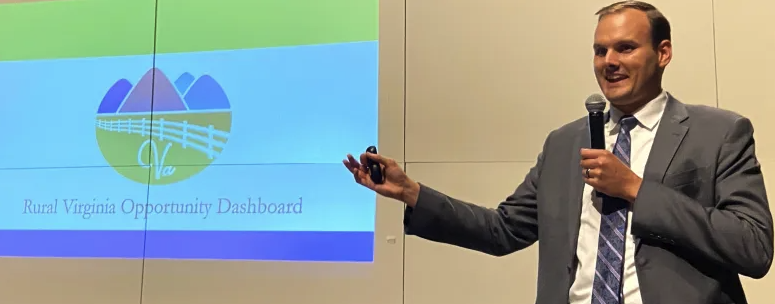
But back to his day job, he reflects that “…this is a really tangible government program. We can actually solve broadband access and track our way to getting that done, see it being built out in the field and congratulate a community because it has changed its economic future.”
Views expressed are the author’s own and do not necessarily represent the official position of broadband.io or its affiliates. Contact Doug Adams at doug@broadbandmarketers.com with any comments or questions.